
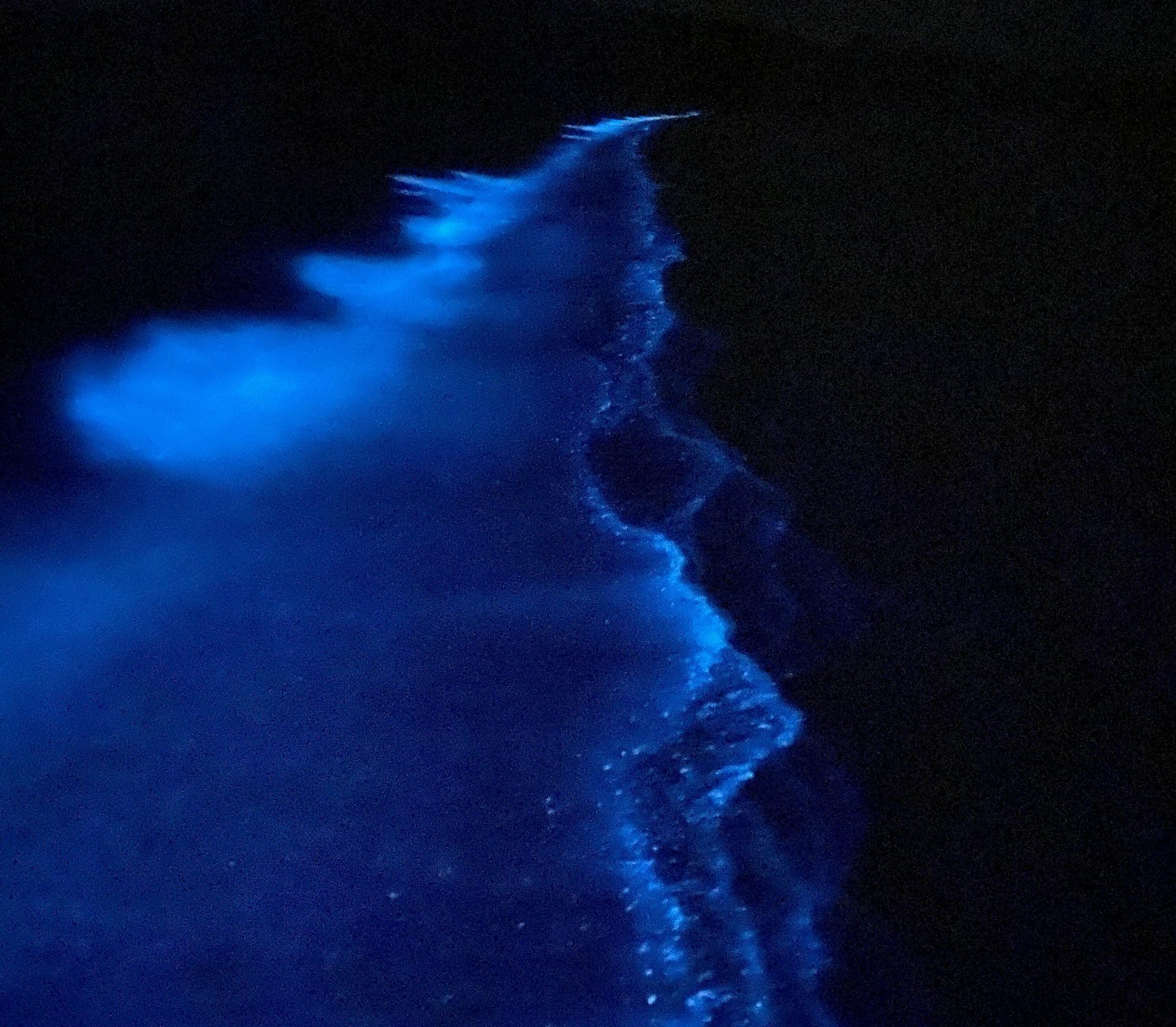
Water that lights up electric blue with every paddle stroke — and Puerto Rico has not one but three glowing bays, all year-round.
The hard part is choosing which one, on which night. This guide clears it up: compare all three, find the darkest nights with the lunar planner, and book with vetted local guides.
Puerto Rico is home to three of the world’s few year-round bioluminescent bays.: Mosquito Bay on Vieques, Laguna Grande in Fajardo, and La Parguera in Lajas. All three glow with the same microscopic organisms, but they differ in brightness, how you get there, and what a bioluminescent bay tour actually looks like once you’re on the water. We built this guide alongside our trusted local outfitters who run these waters every night — comparing all 3 bio bays, pinpointing the best nights to go with our monthly moon planner, and connecting you only with local guides we’ve vetted for the best experience.
Where Puerto Rico’s Glowing Bays Are
Two of Puerto Rico’s bioluminescent bays sit on the main island’s coasts, and the brightest one is on Vieques, a small island to the east. Tap a glowing pin or a card on the map below to jump to that bay’s vetted kayaking tours.
Mosquito Bay
Laguna Grande
La Parguera
Which bay is right for you?
Mosquito Bay — want the brightest, most jaw-dropping version and can spare a night? Go to Mosquito Bay in Vieques.
Laguna Grande — based in San Juan with limited time, or a first-timer? Laguna Grande in Fajardo is easy, reliable, and pairs well with El Yunque.
La Parguera — exploring the southwest of Puerto Rico, or want the quietest night on the water? Head to La Parguera in Lajas, PR.
What Makes the Water Glow?
The glow comes from microscopic single-celled organisms called dinoflagellates — specifically Pyrodinium bahamense, which translates roughly to “whirling fire.” When the water around them is disturbed by a paddle, a hand, or a fish, they emit a brief blue-green flash as a defense mechanism. Multiply that by hundreds of thousands per gallon and you get water that lights up wherever it moves.
Puerto Rico’s bio bays are exceptional because their conditions — warm shallow water, protective mangroves, narrow openings that trap the organisms, and steady nutrients — let these populations thrive permanently, instead of blooming and vanishing like bioluminescence elsewhere. That’s why all three glow year-round.
Quick facts
The Best Time to See the Glow
Timing is the single biggest factor in how bright the bio bay will be — bigger even than which bay you choose. If you take away one thing: the darker the sky, the brighter the glow.
- Dec – April · dry season — most reliable. Minimal rain keeps the water clear so the light travels farther, and the weather is pleasant. Trade-off: it’s peak season — tours sell out well ahead.
- July – Oct · warm water — most vivid glow. Warmer water pushes dinoflagellate concentrations to their peak — an especially vivid, almost neon glow. Catch: it overlaps hurricane season, and a heavy downpour can briefly dim the bay.
☾ The moon cycle — this is the big one. Bioluminescence competes with moonlight. A bright full moon washes the glow out almost entirely — the organisms still flash, you just can’t see them, the way stars disappear in daylight. The sweet spot is a new moon, or within 3–5 days on either side. (At Mosquito Bay, tours are actually prohibited on the nights around each full moon.)
The nuance to know: what really matters is whether the moon is above the horizon during your tour. Even a half or three-quarter moon can be fine if it rises after your paddle or well after midnight — which stretches the usable dark window to roughly 2.5 weeks a month, not just the new-moon night. The planner below does this math for you.
Best Nights to See the Bioluminescence — 12-Month Moon Planner
Our moon calendar scores each night by the moon phase and whether the moon is actually above the horizon during kayaking tour hours — so a bright-phase night can still rank high if the moon rises late. Darker squares = better glow.
Next 2 Weeks — Live Forecast
The northeast coast storms on summer afternoons, but night paddles often clear. The south coast (La Parguera) has the driest skies.
Forecast data: Open-Meteo.com (CC BY 4.0), updated live. Sun, moon phase and moonrise/set times computed in your browser with SunCalc.
Mosquito Bay · Vieques — the Brightest Bio Bay on Earth
Mosquito Bay holds the Guinness World Record for the brightest bioluminescent bay on Earth — a title it’s held since 2006, with up to 700,000 dinoflagellates per gallon. It’s so bright that paddling here has been described as leaving a wake of liquid fire. After Hurricane María in 2017 many feared the bay had gone dark; instead it recovered and came back brighter than ever.
What sets it apart is protection: gas-powered boats are banned, and swimming is prohibited to keep chemicals from sunscreen, lotion and bug spray out of the water — a big reason the bay stays this vivid. You experience it by kayak, some with clear bottoms.
Getting there takes planning. Vieques is reached by ferry from Ceiba (~45 min, roughly $2 each way) or a short Cape Air flight from San Juan (~15–25 min). Both need advance booking — build in a buffer and, if you can, it’s best to spend the night on the island after your tour.
Clear-Bottom Kayaking Bio Bay Tour
Mosquito Bio Bay Kayaking + Esperanza Transport
Mosquito Bay Kayak Tour + Esperanza Transport
Vieques Day Trip from San Juan — Beach & Bio Bay
See all Vieques adventures on TripOutside →
Laguna Grande · Fajardo — the Most Accessible Bio Bay
Technically a lagoon rather than a bay, Laguna Grande sits inside the Cabeza de San Juan Nature Reserve, about 45 minutes from San Juan — which makes it Puerto Rico’s most-visited bio bay and the easiest choice if you’re short on time. You paddle through a narrow, winding mangrove tunnel in the dark before it opens into the glowing lagoon — half the adventure. Tours launch from Las Croabas, the small fishing village at the edge of the reserve — a 45-minute to one-hour drive from San Juan. Several operators also run tours with round-trip transportation from San Juan included — an easy option if you’re staying in the city without a car. Swimming isn’t permitted.
The one downside of Laguna Grande’s popularity is crowds — on busy nights you may share the channel with dozens of kayaks. The fix: book a small-group tour and avoid weekends and holidays. Fajardo also pairs naturally with El Yunque, the only tropical rainforest in the U.S. National Forest System — many travelers do the rainforest by day and the bio bay by night.
Laguna Grande Bio Bay Kayak Tour
Bio Bay Night Kayaking Tour – Fajardo
Marine Biologist Guided Bio Bay Kayak Tour
Bio Bay Laguna Grande Guided Kayak Tour
Bio Bay Kayaking Eco Adventure
Bio Bay Kayak Tour
Full Moon Kayaking Adventure Puerto Rico
Bioluminescent Bay Kayak Adventure
Glowing Bay Adventure – Bioluminescence Kayak Tour
Fajardo Bio Bay Kayaking
Fajardo Bio Bay Kayaking with San Juan Transport
Rainforest River, Bio Bay, Luquillo Beach Trio Tour
Night Bio Bay Kayaking – Transport Included
Full Day Adventure – El Yunque, Bio Bay, River Swim, Beach
See all Fajardo adventures on TripOutside →
La Parguera · Lajas — the Quiet One
Known locally as the Bahía Bioluminiscente or “Phosphorescent Bay,” La Parguera sits on the southwest coast in Lajas, roughly 2 hours from San Juan. It’s the least touristy and most laid-back of the three — a good fit if you’re already exploring the west or south, or want to escape the crowds.
It’s also the most distinctive experience. La Parguera is the bay traditionally associated with swimming in the glowing water — an unforgettable, Avatar-like sensation. Two caveats: regulations across Puerto Rico’s bays have tightened to protect the dinoflagellates, so swimming access has become more restricted and can vary so you’ll want to confirm the current rules with your operator. And because the bay is larger and more open, the glow can diffuse more than Mosquito Bay’s concentrated brilliance; plankton levels also fluctuate week to week.
La Parguera’s mangrove cays and reefs — Cayo Enrique and Cayo Caracoles are the local favorites — make it a strong daytime snorkeling spot too, so you can build a full day around the evening glow — and it has the clearest, driest skies of the three.
Bio Bay Swim & Snorkel Adventure
Bioluminescent Bay Kayak, Swim & Boat Tour
Sunset Bio Bay Kayak, Swim & Boat Tour
Pedal Kayak Bio Bay Tour – La Parguera
Waterbike Bio Bay Guided Tour
See all La Parguera adventures on TripOutside →
Bio Bay Kayaking – What to Know
- Skip the sunscreen & bug spray. Chemicals from lotions, sunscreen and repellent are toxic to the dinoflagellates — many tours ban them outright. Protect yourself with lightweight long sleeves and pants; the mangroves have real mosquitoes.
- Set your camera expectations low. Bioluminescence is notoriously hard to photograph — a normal phone almost never captures it, and chasing the shot means missing the moment. Want footage? Look for an operator that offers professional filming.
- Don’t cancel for a little rain. Cloud cover actually darkens the sky and can help, and raindrops make the plankton sparkle. Only heavy, sustained downpours that cloud the water are a real problem.
- Book early — especially the good dates. New-moon nights in the dry season are the most in-demand window, and popular operators fill up weeks ahead. If your dates are fixed, book the moment you know them.
- Match the boat to your group. Kayaks are the most immersive and interactive; a boat tour is the better call for young kids, anyone with mobility concerns, or travelers nervous about paddling in the dark.
A quick word on conservation. These bays are fragile. The same rules that can feel inconvenient — no swimming, no sunscreen, no gas engines — are exactly what keep the water glowing for the next visitor. Choosing a small, local, low-impact outfitter like our trusted partners on TripOutside. Following Leave No Trace principles is the difference between a bay that thrives and one that goes dark.
Frequently Asked Questions
Which Puerto Rico bioluminescent bay is the best?
It depends on what you want. Mosquito Bay (Vieques) is the brightest in the world but needs a ferry/flight and an overnight. Laguna Grande (Fajardo) is the most accessible — best if you’re based in San Juan and short on time. La Parguera (Lajas) is the quietest and most laid-back, good if you’re exploring the southwest.
Is it safe to swim in a bioluminescent bay?
The glow itself is harmless — the dinoflagellates can’t hurt you, and the water is warm and calm. The restrictions exist to protect them: swimming is prohibited at Mosquito Bay and Laguna Grande because sunscreen, lotion and bug-spray residue damages the ecosystem. La Parguera has historically allowed swimming, but rules have tightened in recent years and access varies — check directly with your operator before booking.
What’s the best month to go?
December through April offers the clearest water and most reliable conditions. July through October brings warmer water and often the most intense glow, with hurricane season as the trade-off. In any month, aim for the days around the new moon.
Can you see the glow during a full moon?
It’s much harder — bright moonlight washes out the effect, so plan around the new moon whenever possible. What matters most is whether the moon is above the horizon during your tour: even a partial moon can be fine if it rises late. A good operator can tell you which nights are darkest during tour hours.
Do you have to go all the way to Vieques?
No. Laguna Grande in Fajardo is under an hour from San Juan and delivers a beautiful experience. But if you want the world’s brightest bay and can spend a night, Vieques is worth the trip.
How do I get to Mosquito Bay on Vieques?
Take the public ferry from Ceiba (~45 min, ~$2 each way) or a short Cape Air flight from San Juan (~15–25 min). Because tours run after dark, plan to spend the night on Vieques. A few operators also run full-day trips from San Juan that include the ferry and the tour.
How much do bio bay tours cost?
Guided night tours run roughly $58–$100 per person for 1.5–3 hours. Fajardo starts around ~$58, La Parguera from ~$59, and Vieques from ~$65. Full-day combos from San Juan cost more. Compare and book on the tour pages above.
Is it worth it?
For most people, yes — it’s the kind of natural wonder photos genuinely can’t capture. Go in with realistic expectations (subtle magic, not a neon rave) and the right conditions — a dark, moonless night — and it’s unforgettable.
Do I need kayaking experience?
No — most tours are designed for beginners. Guides provide instruction and stay with the group. The water is calm and the pace is easy. La Parguera and some Fajardo operators also offer electric/motor boat tours if you’d rather not paddle.
Are the tours family friendly?
Yes. Most welcome ages 4–6 and up (some La Parguera tours accept all ages). Paddling is gentle; for young kids or anyone nervous about paddling in the dark, an electric or motorboat tour is a good call.
What should I bring?
Quick-dry clothes, a towel, water shoes or sandals, and a waterproof phone pouch. Skip chemical sunscreen and bug spray — they harm the organisms; wear light long sleeves against mosquitoes instead.
Ready to see the glow?
Whichever bay you choose, the best way to experience it is with a knowledgeable local guide who knows the water, the mangroves, and exactly which nights will be darkest. Browse vetted, human-powered adventures in Puerto Rico and book direct with the local experts.
Browse Puerto Rico Adventures →