
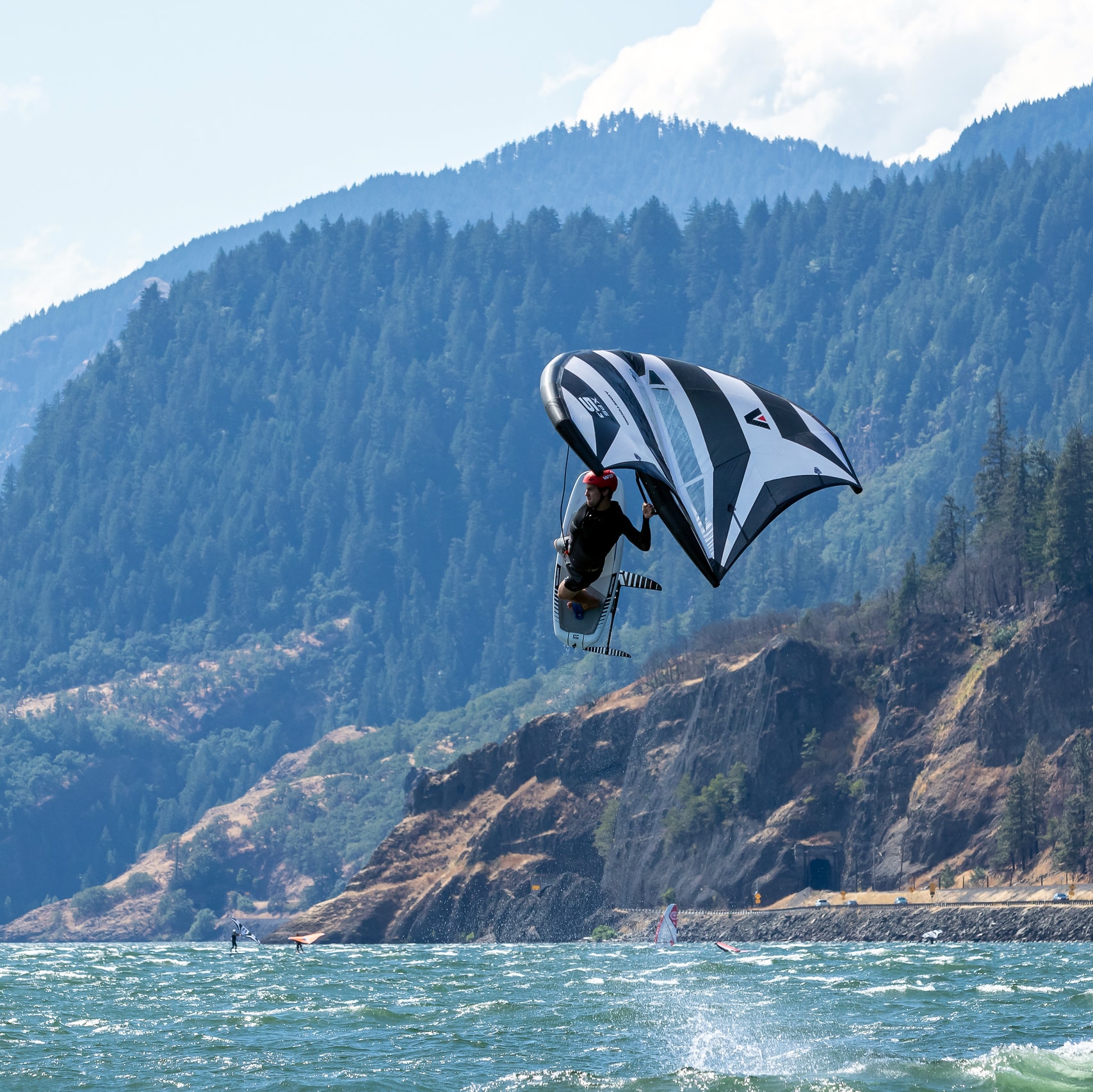
If there’s one place in North America built for learning to wing foil, it’s Hood River, Oregon. The Columbia River Gorge has been a wind-sports mecca for forty years — first for windsurfers, then kiters, then stand-up paddlers, and now for the fast-growing crowd chasing the newest thrill on the water: winging.
To get the real local beta, we sat down with Jodie Gates of Big Winds, one of the largest wind- and water-sports shops in the country. Jodie grew up windsurfing in the Gorge — her family moved to Hood River in 1987 to open Big Winds — and today she’s one of the co-owners keeping the shop’s stoke alive into its 39th season. Here’s what she wants you to know before you plan a trip to learn to wing.

Expert interview
Jodie Gates · Co-owner, Big Winds
Grew up windsurfing the Gorge; her family opened Big Winds in 1987 — now in its 39th season. This guide is her local beta. bigwinds.com

Why Everyone in the Gorge Is Winging Now
Wing foiling has taken over the Columbia River Gorge in just a few years, and once you understand how it feels on the water, it’s easy to see why.
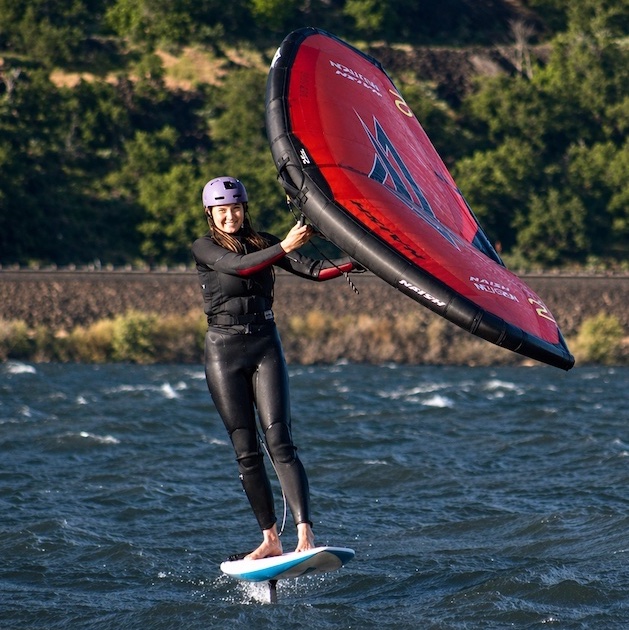
“The foil is so efficient it feels like you’re on a powder day the whole time,” Jodie explains. Where a finned board bumps across the chop like a mogul run, a foil board rises above the surface and glides. “The foil just effortlessly absorbs the chop and moves through it, so it’s really smooth.”
The other draw is how approachable it is once you’re over the initial hump. Windsurfing is a blast, but it can be physically demanding and hard on your joints. Winging, by contrast, can feel remarkably mellow. “It’s a joyful thing,” Jodie says. “You feel like you’re floating a little bit.”
That combination — efficient, forgiving, and genuinely fun — is why so many Gorge athletes have migrated to winging, and why it’s one of the easiest wind sports to fall in love with as a newcomer.
Big Winds: Four Decades of Gorge Wind-Sports Heritage
Big Winds isn’t a chain rental counter. It’s a Hood River institution that has evolved alongside the sports themselves.
Founded by the late Steve Gates in 1987, the shop grew up during the windsurfing frenzy of the ’80s and ’90s, jumped into kiteboarding when it arrived, embraced stand-up paddling next, and — over roughly the last five years — went all in on foiling. “Every decade or so, the sports have evolved,” Jodie says, “and we’ve jumped right into each one.” Today the shop runs under a collective, next-generation ownership group, with the same family roots and the same obsession with getting people out on the water.
What that means for you as a visitor:
- A full retail shop in downtown Hood River, plus a high-performance demo center stocked with the latest intermediate-to-advanced wing foil and SUP foil gear — and even parawing demo equipment as that discipline emerges.
- Seasonal waterfront operations with a dedicated windsurf school and wing school.
- Lessons for every level and age: beginner-through-advanced windsurfing, beginner-through-advanced winging, e-foil lessons, and kids camps that combine windsurf and wing instruction. (Big Winds sells kite gear but doesn’t teach kiting.)
Just as importantly, Big Winds sees itself as your local resource. “People love to go on a mountain biking trip and stop into the local shop to get the beta on the trails,” Jodie says. “It’s the same for us — we love being that resource.” Before you paddle out, walk in and ask about the day’s conditions and where to launch. It’s one of the most valuable parts of visiting the Gorge.
When to Go: Hood River’s Wind Season
The heart of the season runs Memorial Day weekend through Labor Day, with reliable conditions stretching from roughly May into September. That window also happens to be the driest stretch of the year, which matters more than you’d think — rain tends to muck up the wind.
July is the crown jewel. “We’ve often looked back at Julys and said, ‘I think it was windy every single day of the month this year,'” Jodie says. On a good day the wind can start cranking as early as 4 a.m. and hold until sunset.
When to go
The Hood River wind calendar
Tap a month. The season runs reliably May–September — and July is the crown jewel.
◢ Memorial Day → Labor Day: the heart of the season ◣
Why the wind blows here
The Gorge is essentially a natural wind machine. In summer, the high desert on the eastern side of the Cascades heats up far more than the Portland side to the west. That temperature difference funnels a strong westerly wind straight through the gorge — and because it blows against the river’s current, it kicks up the swell the Gorge is famous for. (In winter the pattern flips to easterlies, creating a completely different feel on the water.)
Why it works
The Gorge is a natural wind machine
Hot desert air east of the Cascades rises; cool marine air rushes in from the west to replace it — funneled straight down the Gorge, against the river’s current. Wind against current = the swell the Gorge is famous for.
In winter the pattern flips to easterlies — a completely different feel on the water.
Water temps and what to wear
Wetsuit needs shift a lot across the season:
- Early season (spring): water around 50°F. Expect a 5/4 or 4/3 wetsuit, and many locals still wear warm booties and gloves.
- June: you can usually drop down to a 3/2.
- July–August: shorties come out, and by August the river often warms past 70–72°F — comfortable enough for board shorts.
There’s real personal preference here, so when in doubt, ask the shop what people are wearing that week.
What to wear
Wetsuit picker
Water temps swing a lot across the season. Pick when you’re coming:
Lots of personal preference here — when in doubt, ask the shop what people are wearing that week.
Where to Ride: Launches by Skill Level
One of Hood River’s underrated advantages is space. Launches stretch across many miles of river, so it’s easy to spread out and find a spot that matches your ability and the day’s wind. A few of the key ones:
- The corridor (downtown Hood River): Waterfront Park is one of the most popular launches — friendly for beginners, intermediates, and advanced riders alike — with the Event Site right next door. Because they’re so close to town (and near the sandbar, one of the few easy kite launches), these can get busy.
- Out east: launches toward The Dalles and even as far as Arlington, a couple of hours away.
- Washington side: Swell City and the Hatchery are classic names — better suited to intermediate and advanced riders.
- Farther west: Viento on the Oregon side, and Stevenson across the river in Washington.
Because wind can be isolated to certain stretches on any given day, the single best move is to check in with Big Winds before you head out. As Jodie puts it, it’s easy to make a good recommendation once they know your skill level and where the wind is blowing.
Where to ride
Launch explorer — west to east
Launches stretch across many miles of river. Filter by your level — then check in with the shop for the day’s wind.
How to Learn to Wing in Hood River
Here’s the part every first-timer wants to know: how do you actually get started, and how much time should you budget?
A beginner spot that’s a “slam dunk” for safety
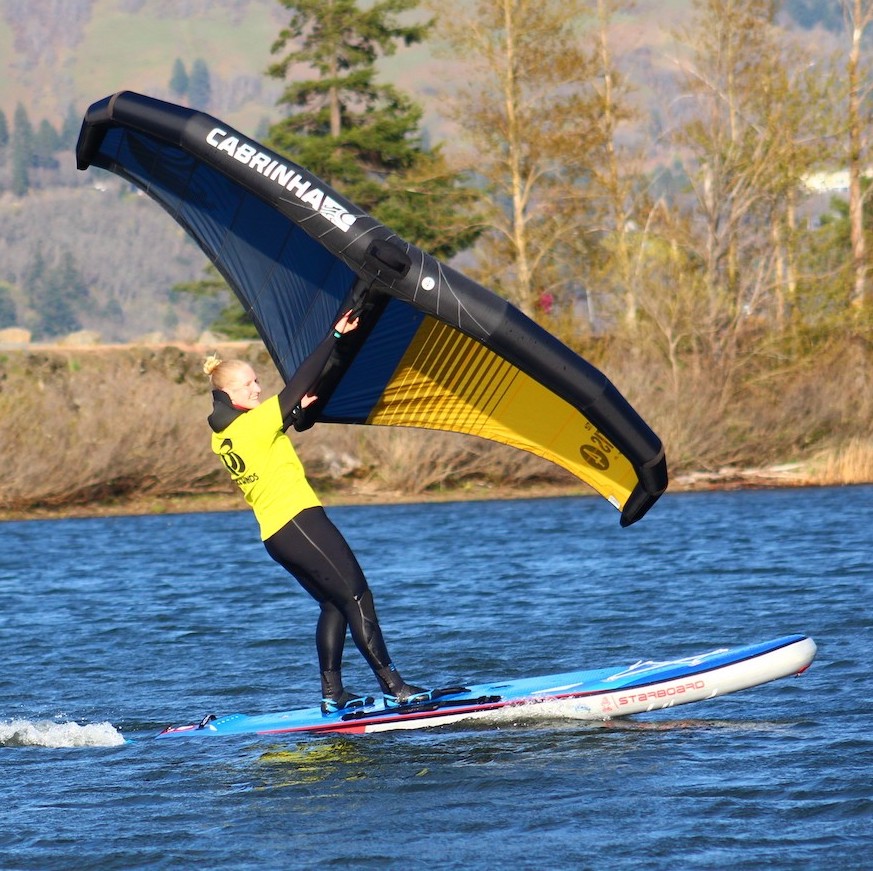
Big Winds runs its beginner lessons out of The Hook — a man-made inlet tucked outside the main channel of the river. It’s calm, shallow, and remarkably low-consequence. “The biggest problem you could get into is drifting downwind to the other end and having to walk back in shallow water,” Jodie says. “Safety-wise, it’s a slam dunk.” It’s where they teach kids and adults of every comfort level.
Just outside The Hook, an intermediary channel lets you get a taste of the main river’s energy for intermediate lessons — including your first time with a foil under the board — before you graduate to the open launches.
The progression and how much time to plan
For winging, the foil is where you’ll spend the bulk of your practice time, so the typical path looks like this:
- An initial wing lesson on a board without a foil, to learn to handle the wing.
- Foil lessons to get up on foil. Big Winds offers a discounted three-lesson bundle — for example, one wing lesson plus two foil lessons, or a mix that swaps in an e-foil lesson to fast-track the foiling feel.
- Rental time to practice on your own, then a conversation about buying gear once you’re ready to ride consistently.
As for timing: a long weekend stacking lessons is the bare minimum. A full week is ideal, because you can layer in rental time between lessons and actually reach the point where you’re heading out independently and thinking about your own kit.
How long to plan
Your learn-to-wing trip, day by day
Built around Big Winds’ three-lesson bundle (one wing-handling lesson + two foil lessons, or swap in an e-foil).
Illustrative plan — the shop will sequence lessons around your pace and the wind.
Beyond Winging: Downwind SUP Foiling and Parawing
If you catch the bug, the Gorge is also ground zero for two of the sport’s most exciting frontiers.
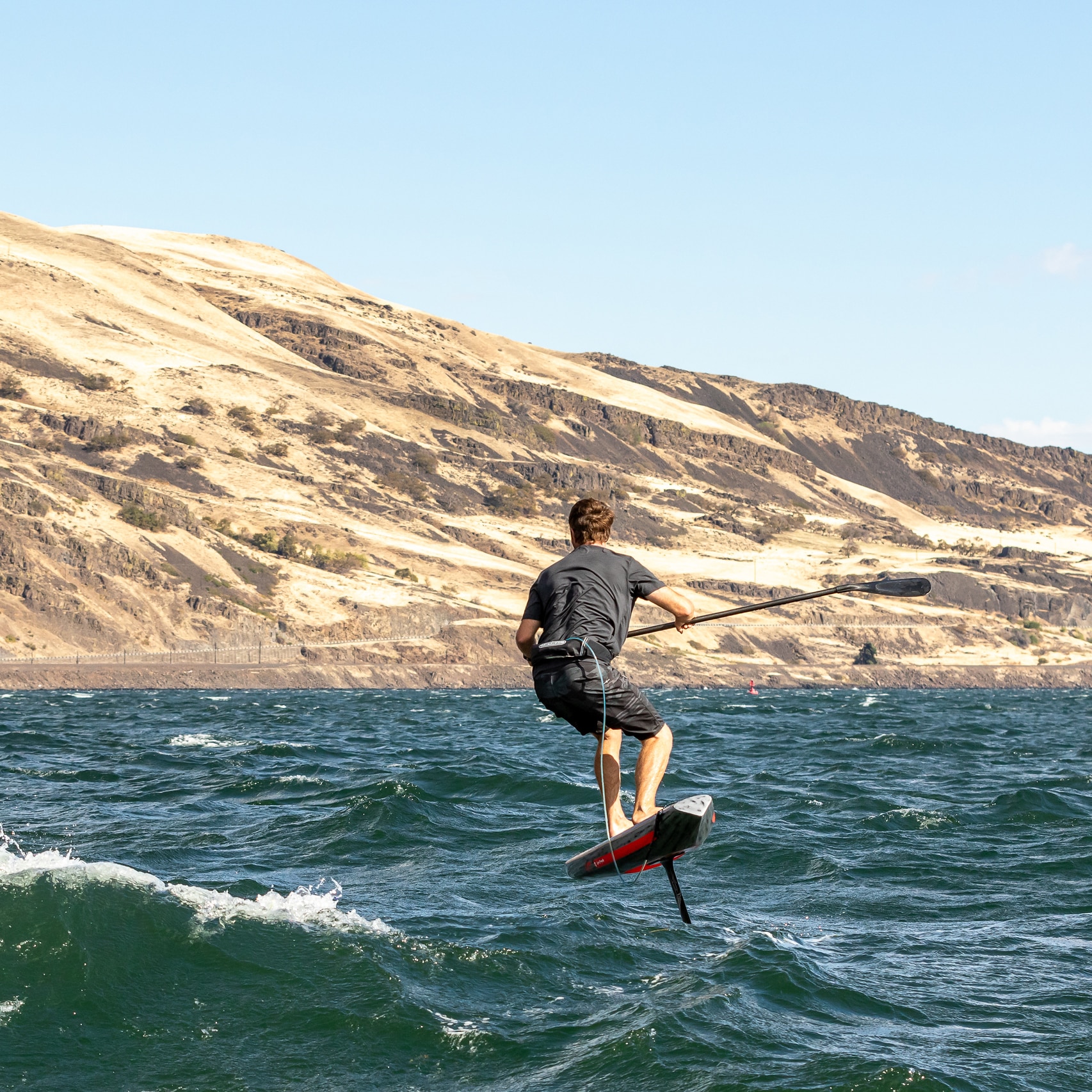
Downwind SUP foiling strips things down to a board, a foil, and a paddle — no wing, no wind assist. It evolved out of the downwind SUP runs that peaked around 2015, and it usually involves a shuttle since you’re only going one way. The learning curve is longer and the workout is serious, but riders describe it as one of the purest ways to use the river.
Parawing is the newest wave, and it’s taking off fast. Think of it as a bridge between winging and downwind foiling: you use a small, packable wing to get yourself upwind, then stash it and ride downwind on foil — a self-shuttle that captures that pure, hands-free feeling.
“The evolution is happening all the time,” Jodie says. In the Gorge, that’s part of the fun.
Where to Stay and What Else to Do
Hood River is a genuinely great basecamp — even for travel companions who never touch the water. Between sessions there’s mountain biking, hiking, wineries, breweries, orchards, and fruit stands. “There’s kind of an endless supply of things that are just lovely to do,” Jodie says.
A few planning notes:
- Book early. July is peak season and a popular wedding destination, so hotels and Airbnbs fill up fast.
- Consider White Salmon. Just across the river in Washington, this smaller town has great restaurants, a bakery, and a wine bar — and from its bluff you get a special view across to Mount Hood and the Hood River waterfront.
- Stay near downtown if you can. The downtown core and the waterfront zone are walkable and fun, and you’re minutes from the launches.
Plan Your Hood River Wing Trip
Hood River earns its reputation: consistent summer wind, a beginner-friendly place to learn, launches for every skill level, and a town that’s a pleasure to hang around in on the rare glassy day. And with a shop like Big Winds, you’re not just renting gear — you’re plugging into four decades of local knowledge.
Have questions before you go? Reach out through TripOutside and we’ll connect you with the Big Winds team to plan the right lessons for your trip.
Ready to fly?
Book your Hood River wing trip
Lessons run out of The Hook — the calm, shallow, “slam dunk” safe beginner spot — with rentals and demo gear in town.