
Firsthand Review
By Reet, co-founder of TripOutside | Based in Durango, CO | Visited Santa Fe in April 2026 with co-founder Julie | TripOutside is a member of The Conservation Alliance and Leave No Trace
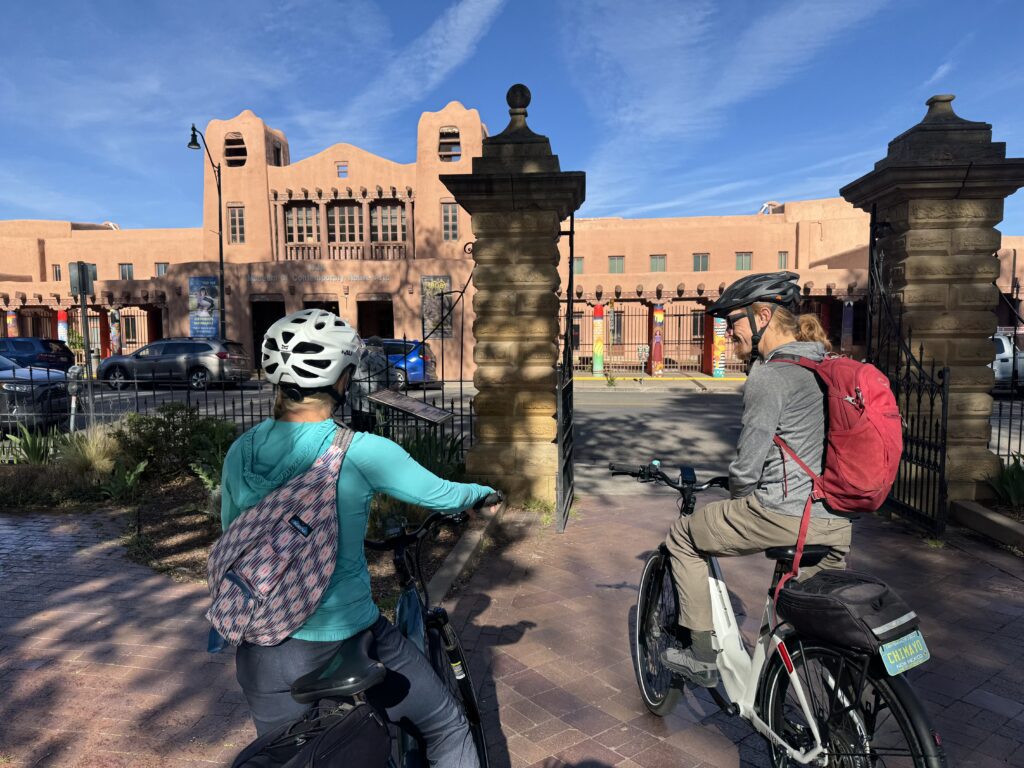
Last updated: May 2026. Based on a guided e-bike tour Julie and I took in Santa Fe in April 2026.
There’s something magical about rolling up to a 175-year-old cathedral on an e-bike, listening to your guide describe the French Jesuit archbishop who shocked a city of adobe by importing Italian stonemasons. You couldn’t have heard that story from a tour bus window. You couldn’t have stumbled onto it walking, either — not in the same afternoon you’d also pedal out to a 375-year-old farming village and stand at the spot where Santa Fe Trail wagons first heard the church bells after six months on the plains.
Julie and I have been building TripOutside around human-powered adventures for years now, and we’ve taken our share of guided tours across the West. When we visited Santa Fe in April 2026, we deliberately chose an e-bike tour as our way in on our first day in town. Here’s why that decision turned out to be the right one, and why we’d recommend the same approach to anyone visiting Santa Fe for the first time.
Why Santa Fe Rewards an E-Bike Tour More Than Most Cities
Santa Fe is 415 years old. Let that sink in. While the Pilgrims were still a generation away from Plymouth Rock, Spanish governors were already arguing in the Plaza about how to treat the Pueblo people — and those arguments would eventually erupt into one of the most remarkable events in the history of the Americas.
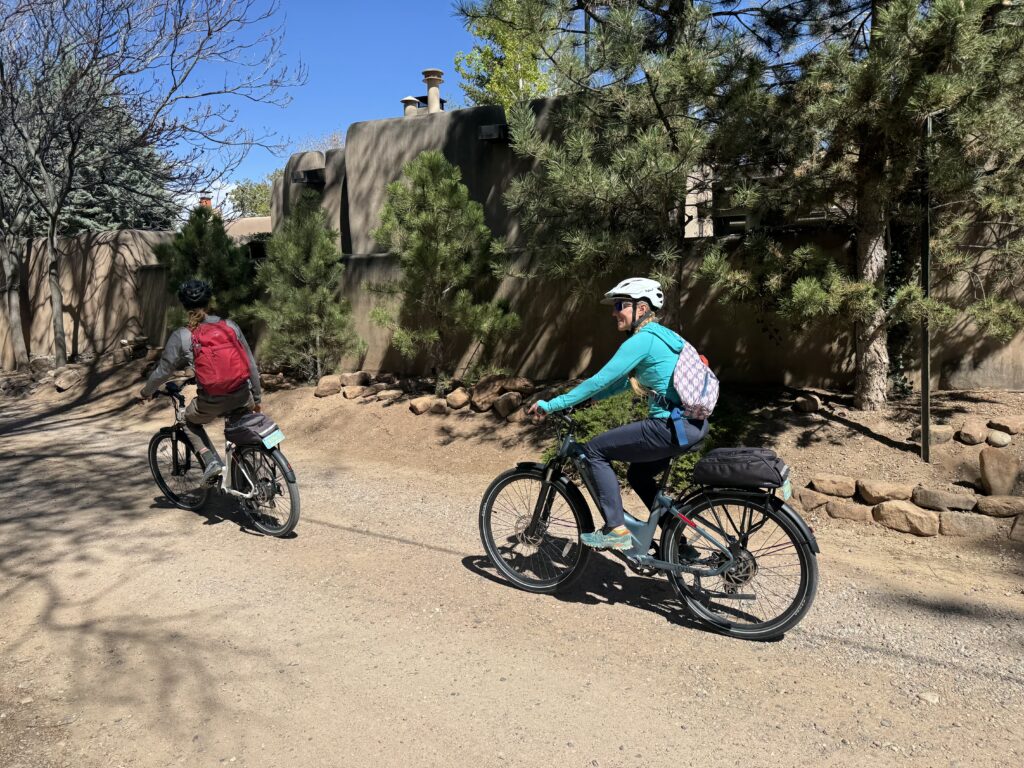
The catch is that Santa Fe’s stories don’t all live in one place. The Plaza is the historical heart, but the city’s narrative radiates outward — Museum Hill to the south, the old farming village of Agua Fría to the west, the cathedral district just off the Plaza, the entrances to the old Camino Real and Santa Fe Trail in different directions entirely. On foot, Julie and I would have seen maybe a quarter of it in a day. In a car, we’d have missed the details entirely — the adobe alleyways, the acequias still running, the way the light hits an 1850s stone facade differently than the 1700s mud wall right next to it.
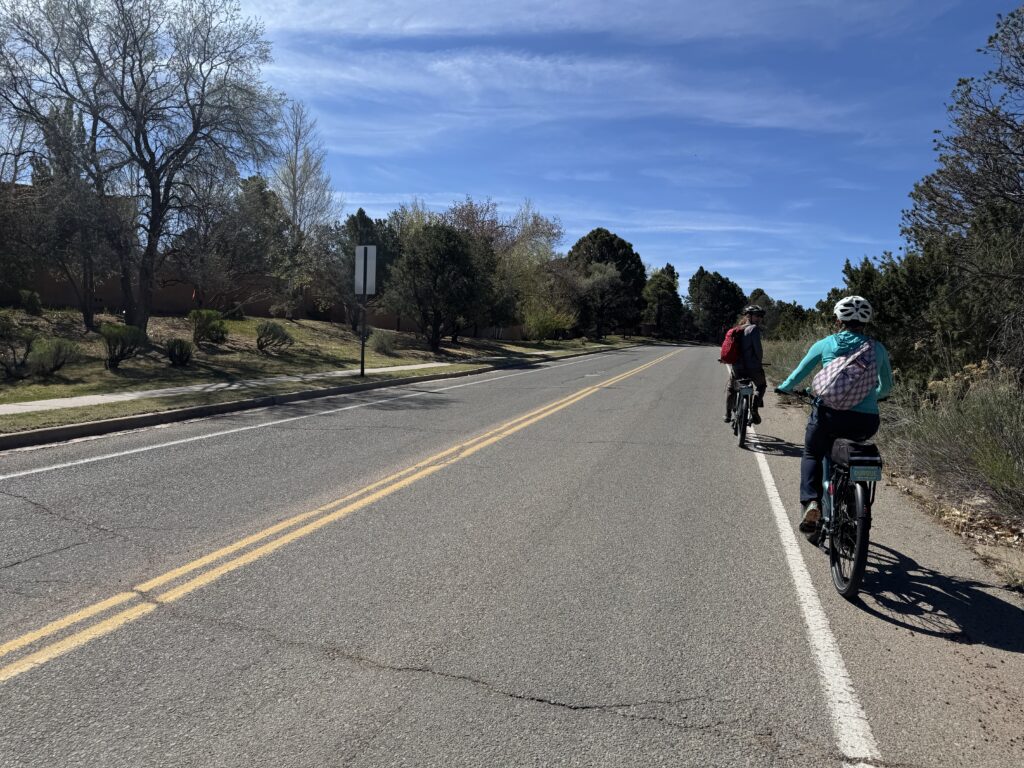
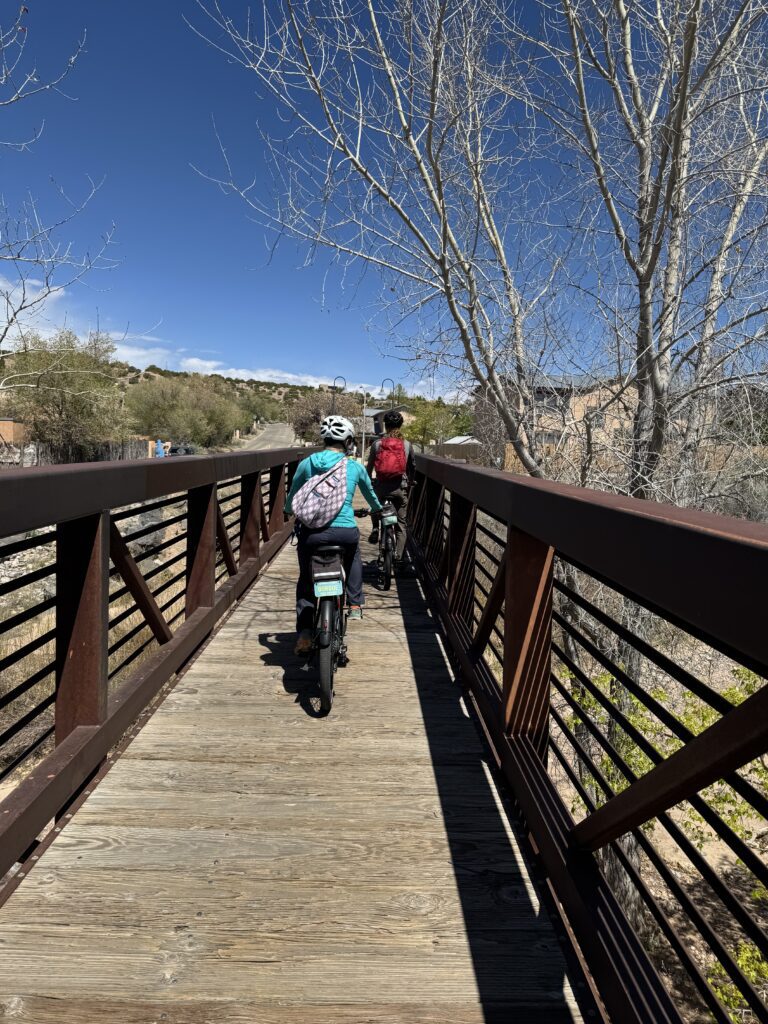
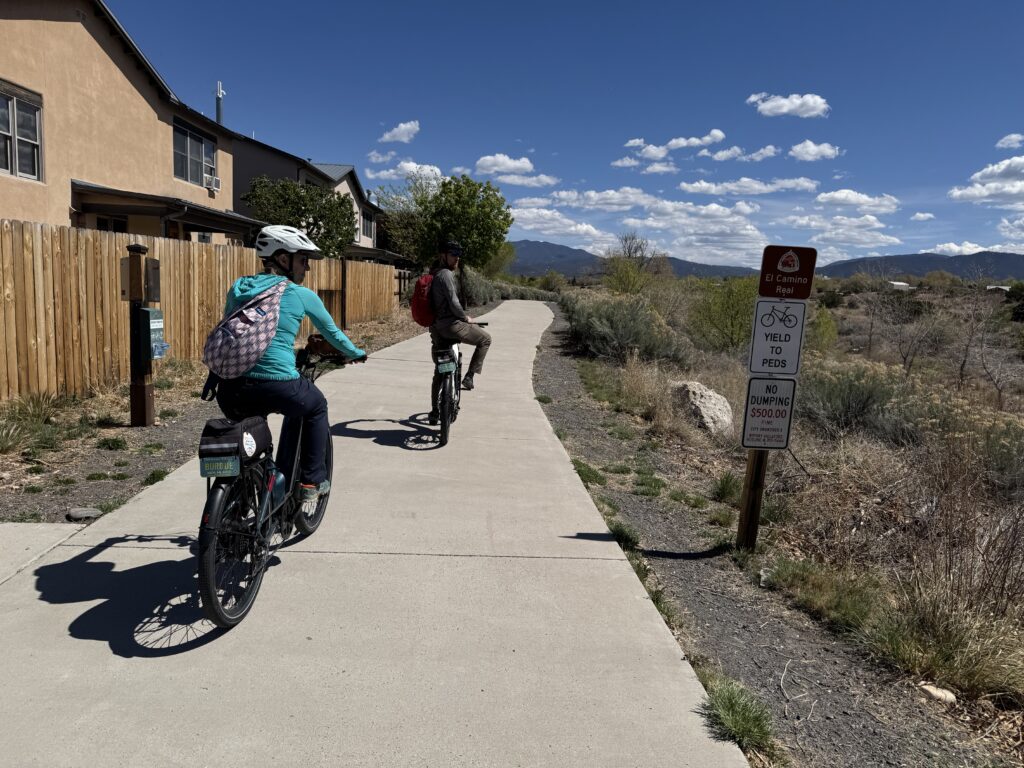
An e-bike threads the needle. We covered real ground without arriving sweaty or exhausted. Santa Fe sits at 7,200 feet, and even though we’re acclimated to elevation in Durango, we still felt the climbs — pedal assist made those grades disappear. We were moving slowly enough to actually see things, fast enough to connect them, and our guide was right there pointing out what we’d otherwise have rolled past.
The stop-on-a-dime factor is what most people don’t think about until they’ve experienced it. When our guide pointed out a bronze sculpture commemorating a little girl who walked the Santa Fe Trail ten times because her family were traders (the wagons were loaded with goods, so people walked alongside) — we stopped. We took it in. We stood at the exact spot on Museum Hill where wagon trains first heard the Plaza church bells after six months on the road. You cannot do that from a tour bus.
The Pueblo Revolt: The Story That Anchored Our Tour
The single piece of history that made the biggest impression on Julie and me was the 1680 Pueblo Revolt. I knew the broad strokes going in. I did not know the details until our guide walked us through them in the Plaza itself.
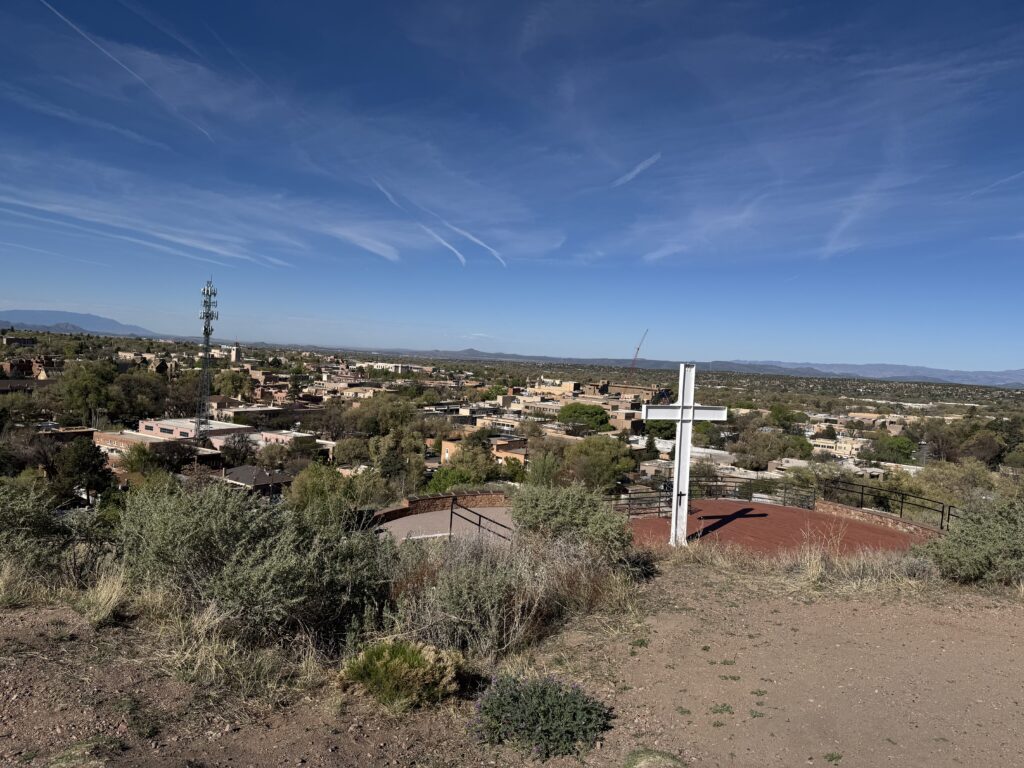
By 1680, the Spanish had been in New Mexico for about a century. Policies toward the Pueblo people swung wildly depending on which captain-governor was in power — some pushed peace and trade, others viewed the natives as barbarians to be exterminated. A century of disease, enslavement, and forced religious conversion had built up a tremendous reservoir of resentment. The tipping point came when Spanish authorities executed a renowned Pueblo spiritual leader.
What happened next is genuinely staggering. Forty pueblos coordinated a rebellion using runners moving through the night with secret messages, evading Spanish patrols. Their armies converged on Santa Fe from every direction, herding the entire Spanish population of New Mexico into the Plaza like sheep. They set the city on fire. Twenty-one of the 33 priests in the territory were executed on the Plaza while Spanish officials watched from the windows of the Palace of the Governors.
The Spanish fled. They stayed gone for 13 years.
It is the only time in the entire Western Hemisphere that an indigenous population overthrew a European power and held the territory for any meaningful length of time.
When the Spanish finally returned in 1693, they came back with a completely different attitude. No more forced conversions. A grudging tolerance that allowed Pueblo languages, feast days, and dances to survive intact — a continuity you can still see across the New Mexico pueblos today. Standing in the Plaza while our guide laid this out, with the Palace of the Governors right in front of us, was the single moment of the trip Julie and I keep coming back to.
What We Actually Saw on the Tour
Our guided e-bike route wove together several distinct chapters of the city’s history in a single afternoon. Here’s what stood out:
The Plaza and the Palace of the Governors
Ground zero for the Pueblo Revolt, the heart of Spanish colonial administration, and the southern terminus of the Santa Fe Trail. Our guide spent extra time here, and rightly so. This is the layer cake of Santa Fe history — Pueblo, Spanish, Mexican, and American eras all stacked on the same dirt.
The Cathedral Basilica of St. Francis of Assisi
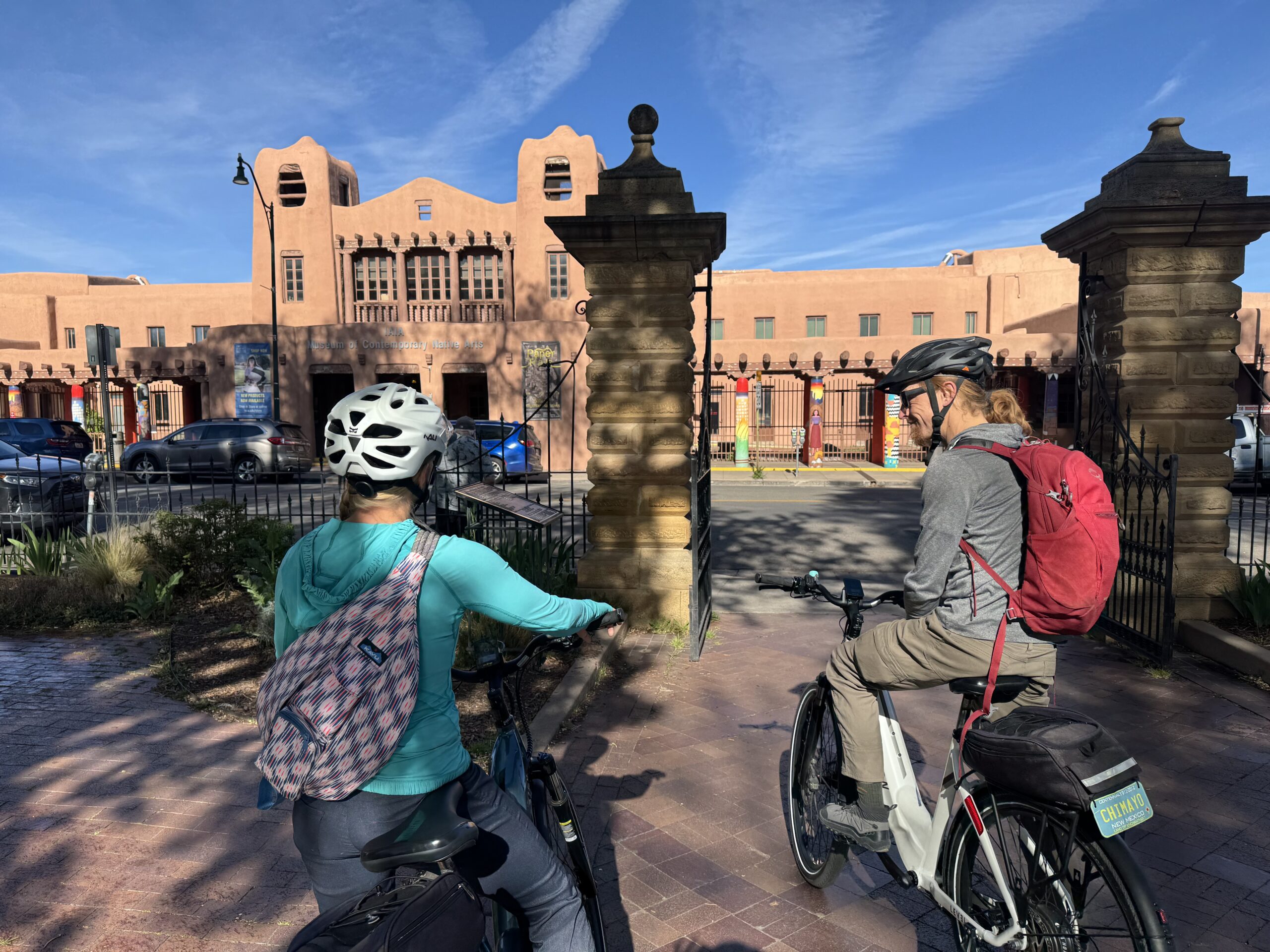
A stone cathedral that does not look like it belongs in New Mexico — and that’s exactly the point. After the U.S. took over the territory in 1846, the Pope appointed a French Jesuit archbishop who arrived in what was then a dusty little mud town of ramshackle adobe homes and decided Santa Fe was going to join the modern world. He imported Italian and French stonemasons who had experience working with massive blocks of European-style stone. The cathedral that resulted, built starting in the 1850s, was the first stone cathedral in New Mexico.
The little adobe chapel still tucked behind the cathedral is the original. The scale difference between the two tells you everything about what the 1850s did to this city. If you have time, walk inside — the architecture is stunning, and the contrast between the old chapel and the new cathedral is the kind of thing photos don’t capture.
The Santa Fe Trail Terminus on Museum Hill
This was Julie’s favorite stop. There’s a bronze sculpture marking the spot where exhausted traders first heard the Plaza church bells after six months on the trail. Our guide explained the choice traders had to make at Fort Dodge: the Cimarron Cutoff (more direct, but you crossed long stretches with no dependable surface water and had to negotiate with the Kiowa-Comanche for access to seasonal wells) or the Mountain Route (more water, but you had to take wagon convoys over Raton Pass before there were highways).
Both routes converged at Fort Union near Las Vegas, New Mexico, then ran south through Glorieta Pass into the Rio Grande Valley. Standing at the sculpture and imagining the relief of seeing Santa Fe after that journey is the kind of moment a guided tour earns its price for.
Agua Fría
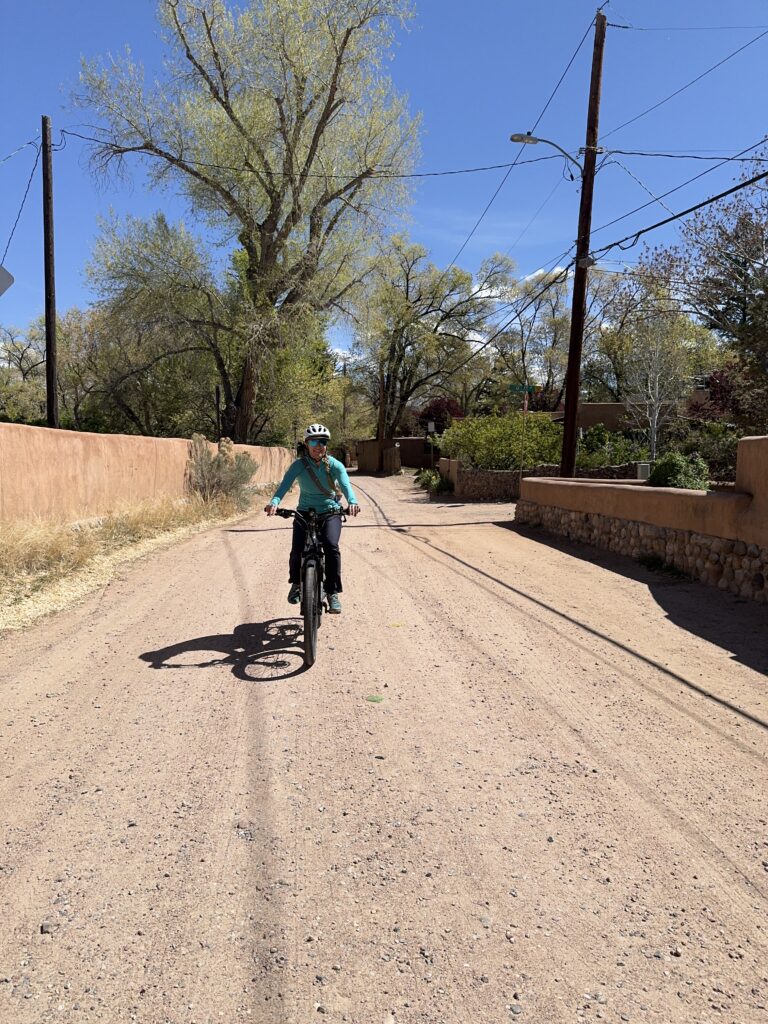
A 375-year-old farming village now absorbed into Santa Fe, where the original acequia madre still runs and dumps back into the river. This was the last resupply stop on the Camino Real before you reached the Plaza, and the first one when you left — a place to fix a wagon wheel or trade for apples from the orchards. Most visitors to Santa Fe never make it out here. We did, and it was one of the quieter highlights of the day.
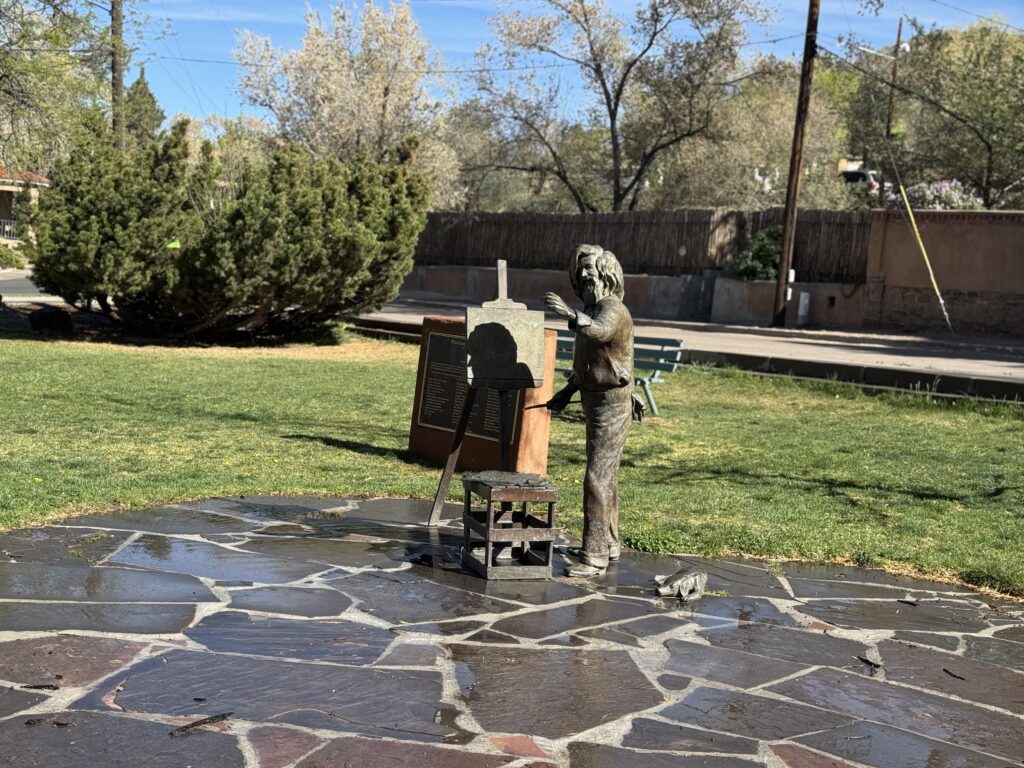
The Sculpture
Santa Fe is one of the great American sculpture cities. Some of the finest large-scale bronze work in the country sits along these routes, and an e-bike lets you actually stop and look at it rather than catching glimpses through a windshield.
The Practical Stuff (For Anyone Planning Their Own Trip)
Here’s what we wish we’d known going in:
- Tour length: Plan on two to three hours of riding plus stops. Ours ran a little over three hours and we never felt rushed.
- Distance: Ours was around 15 miles and 1000 ft of climbing, but it may vary on the route your guide chooses for your group.
- Fitness: Genuinely accessible to anyone comfortable on a bike. Pedal assist erases the climbs. Julie and I are both lifelong cyclists, and we still appreciated it at 7,200 feet.
- What to bring: Water, a layer (April mornings in Santa Fe were cool even when afternoons warmed up nicely), sunglasses, and a real camera if you have one. The light in northern New Mexico is the reason artists never leave.
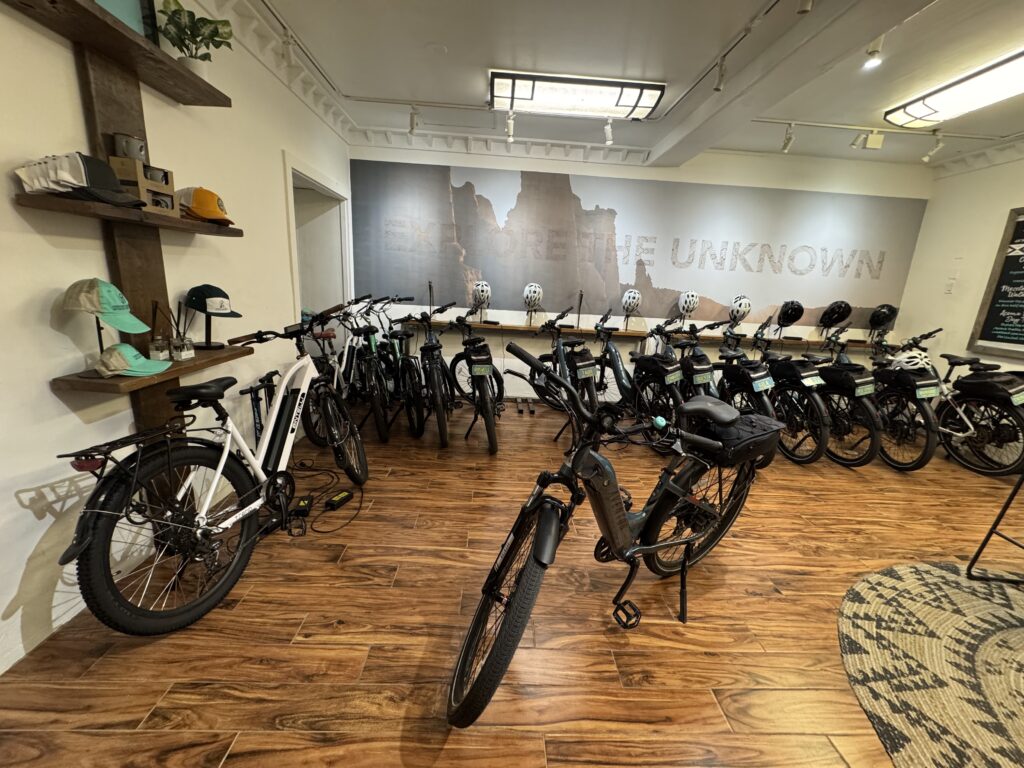
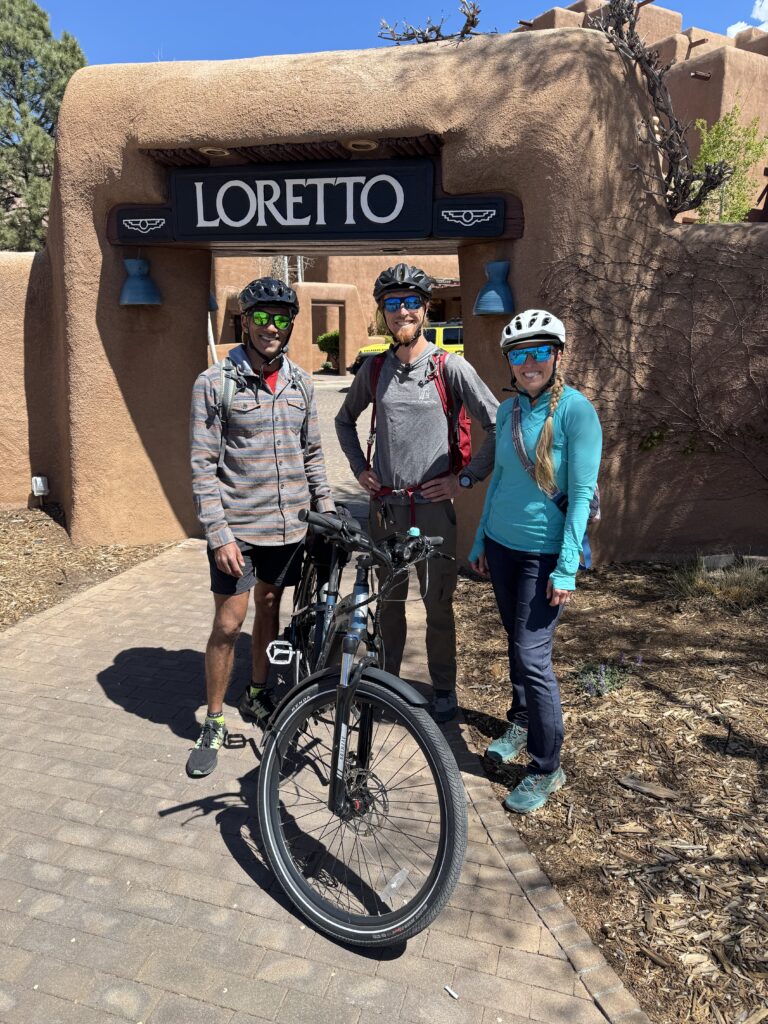
- What’s provided: Bike, helmet, route, and most importantly, the guide. A good guide is the entire difference between this tour and renting an e-bike on your own.
- Best time of year: We went in April and the weather was excellent — cool mornings, warm afternoons, low crowds. Fall is reportedly equally good. Summer afternoon thunderstorms are something to plan around.
Why Guided Beats Self-Guided in Santa Fe
You could rent an e-bike on your own in Santa Fe. People do. But the difference between riding past the Plaza and understanding the Plaza is the difference between a vacation photo and a memory you’ll carry home.
The stories I shared above — the runners moving through the night in 1680, the little girl who walked the Santa Fe Trail ten times, the French archbishop who couldn’t believe what he was seeing — those don’t come from plaques. They come from a guide who has spent years living in this city and learning its layers. Julie and I have done plenty of self-guided trips, and we love them. Santa Fe is not where we’d choose that approach.
The TripOutside Take
We built TripOutside around the belief that the best outdoor experiences come from local outfitters who know their place deeply — and who operate in a way that respects the land and culture they’re showing you. Santa Fe is one of the clearest examples of why that matters. The city’s history is layered, contested, and still very much alive in the Pueblo communities that surround it. A good guide carries that responsibility well.
If you’re planning a Santa Fe trip and you’re trying to decide how to spend your first afternoon in the city, this is what we’d tell a friend: book the guided e-bike tour. Do it on day one. Everything else you do for the rest of the trip will make more sense because of it.
Four hundred years of history. Pedal assist on the hills. Your guide doing the heavy lifting on the storytelling.
That’s a good afternoon. Ours was.
Ready to explore Santa Fe by e-bike?
TripOutside partners with vetted local outfitters running guided e-bike tours through Santa Fe’s historic core. Every outfitter we work with is hand-selected for safety, expertise, and conservation alignment.
About this review: Reet and Julie, co-founders of TripOutside, took this guided e-bike tour in Santa Fe in April 2026. TripOutside is a curated marketplace for human-powered outdoor adventures, and a member of The Conservation Alliance and Leave No Trace. We only feature outfitters we’ve personally vetted for quality, safety, and conservation values.
Editorial independence: This post reflects our genuine experience. TripOutside earns commissions on bookings made through our affiliate partners, but our editorial recommendations are based on firsthand experience and outfitter vetting — not commission rates.